
Your Mouth Notices When You Stop Smoking
How smoking affects your gums, teeth, breath, healing and long-term oral health
Stopping smoking is usually talked about in terms of lungs, heart health and breathing.
Your mouth deserves a place in that conversation too.
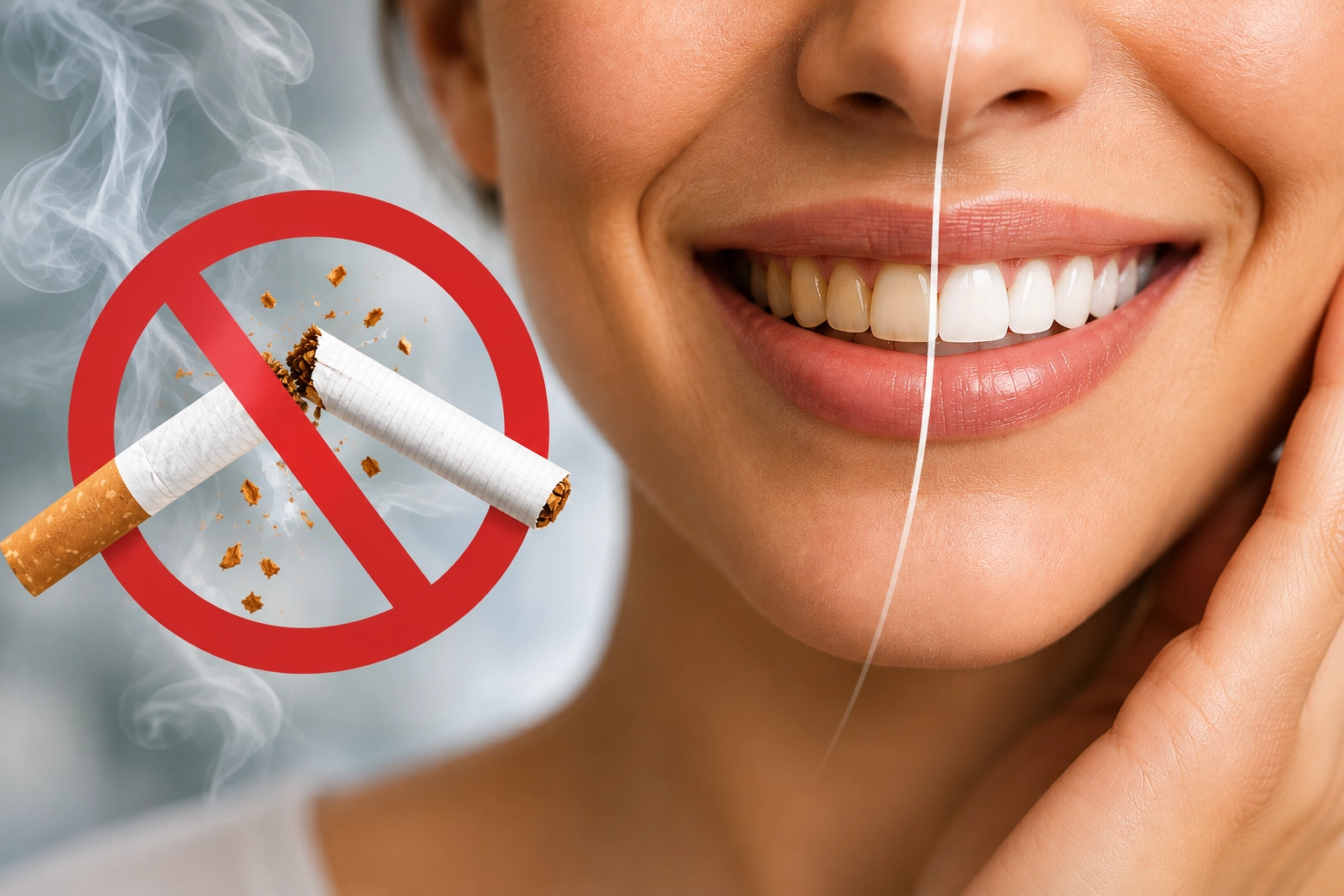
Smoking affects much more than the colour of your teeth. It changes the way your gums respond to bacteria, makes gum disease harder to spot, slows healing and can complicate treatments such as dental implants. It is also one of the major risk factors for mouth cancer.
That is why Stoptober is a useful moment to look at something people do not always connect with quitting smoking: what happens inside your mouth when you stop.
Smoking and oral health: what changes in the mouth?
Smoke comes into direct contact with your teeth, gums, tongue, and the tissues lining your mouth every time you smoke.
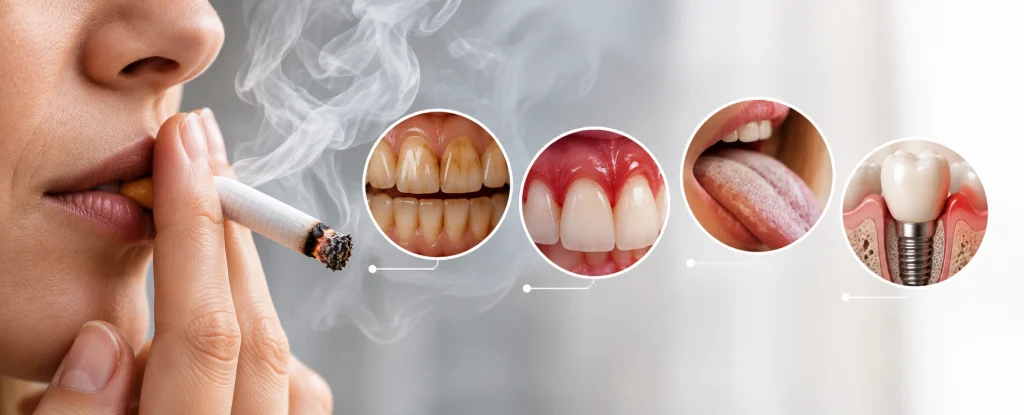
Over time, that can show up in several ways. Teeth may become more stained. Breath can be affected. Gum disease becomes more likely and can progress more quickly. Healing after dental treatment may also be less predictable.
What makes smoking particularly tricky from a dental point of view is that some of the damage can be quieter than people expect.
You may not necessarily see dramatic symptoms early on.
And that matters most when it comes to your gums.
Can smoking cause gum disease?
Smoking is a major risk factor for gum disease.
Gum disease begins when plaque builds up around the teeth and gums. If that plaque is not properly removed, the gums become inflamed. In more advanced cases, the tissues and bone supporting the teeth can start to break down.
UK preventive dentistry guidance specifically identifies tobacco as a risk factor for periodontitis and recommends that dental teams routinely encourage patients who smoke to stop.
Smokers can also develop more plaque, and gum disease may progress more quickly than it does in non-smokers.
This is one reason regular dental examinations and hygiene appointments matter so much if you smoke.
Why bleeding gums may be harder to spot in smokers
Here is one of the stranger things about smoking and gum health.
People often associate bleeding gums with gum disease, and rightly so. But smokers may have significant gum problems without seeing as much bleeding as they would expect.
Smoking affects blood flow in the gums. That means one of the most obvious warning signs of inflammation can be reduced or masked.
So “my gums do not bleed” does not necessarily mean “my gums are healthy”.
This is exactly why gum checks matter. Your dentist or hygienist can look for pocketing, recession, plaque build-up, bone changes and other signs that are much harder to judge at home.
Smoking, tooth staining and bad breath
This is the part people tend to notice first.
Smoking can leave yellow or brown staining on the teeth, particularly around areas where plaque and tartar collect.
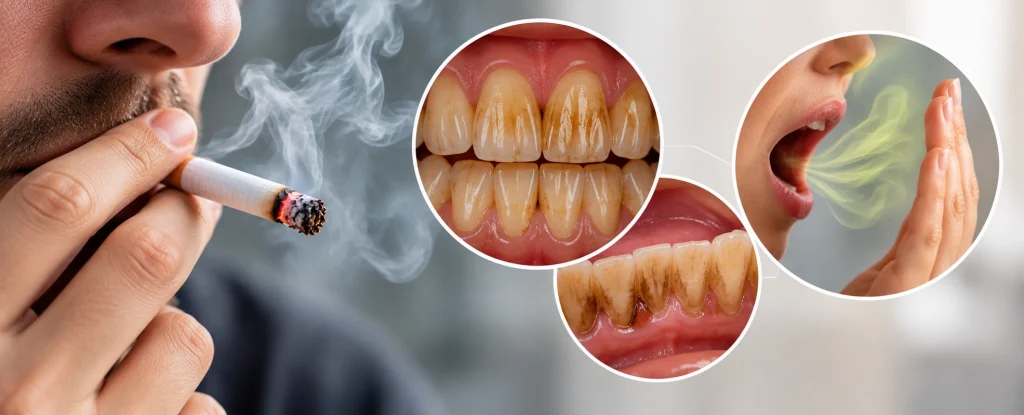
Professional hygiene treatment can remove many external stains and deposits, although it cannot change the natural colour inside the tooth in the way professional whitening can.
Smoking can also contribute to persistent bad breath.
That is partly because smoke itself lingers, but it can also be linked with plaque, gum inflammation and changes in the mouth caused by tobacco use.
Stopping smoking does not instantly undo every stain, but it stops adding more of the same problem day after day.
That is a good place to start.
What happens to your mouth when you stop smoking?
Your mouth does not suddenly reset the day you stop smoking, but you remove an important ongoing risk factor.
The gums are no longer being continually exposed to tobacco smoke, and your dental team can work with you to manage plaque, inflammation and any existing periodontal disease without smoking constantly working against the healing process.
If your teeth are stained, stopping also means professional cleaning or whitening is not immediately competing with new tobacco staining.
And perhaps most importantly, stopping smoking reduces your future exposure to one of the established risk factors for mouth cancer.
You do not need a perfect mouth on day one of quitting.
You just need to stop adding to the problem.
Can quitting smoking improve gum health?
Yes, quitting smoking is an important part of protecting your gums.
That does not mean existing gum disease simply disappears. If periodontitis is already present, it still needs proper assessment, cleaning and ongoing maintenance.
But removing smoking from the equation gives the gums a better environment in which to respond to treatment.
The NHS includes stopping smoking as part of both the prevention and management of gum disease.
So if Stoptober is the month you stop, it is also a very good time to find out where your gum health currently stands.
Does smoking slow healing after dental treatment?
It can.
Good healing depends on healthy blood supply, immune response and the body’s ability to repair tissue. Smoking interferes with that process.
This is relevant after extractions, gum treatment, oral surgery and implant placement.
For some treatments, your dentist may specifically advise stopping smoking before and after the procedure because healing matters to the final result.
That does not mean smokers cannot have dental treatment. It means smoking needs to be part of the treatment discussion rather than something left out of it.
Smoking and dental implants: why healing matters
Dental implants depend on the implant forming a strong relationship with the surrounding jawbone and on the gums around it remaining healthy.
Smoking makes that more difficult.
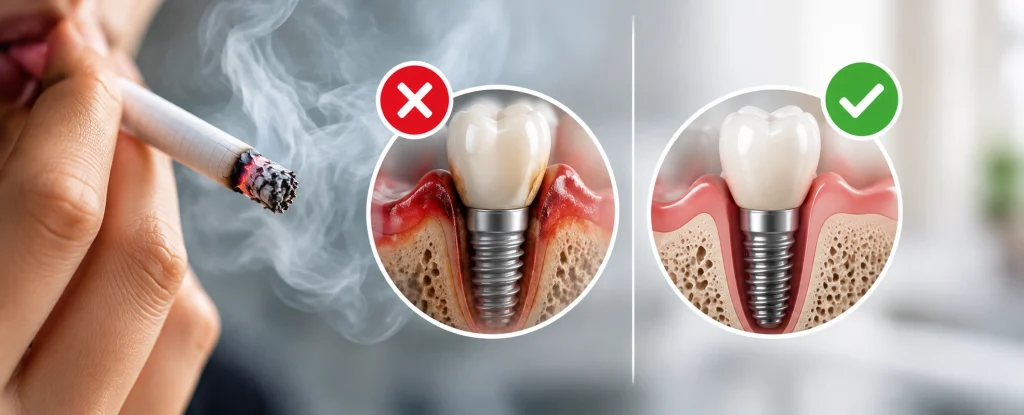
UK government guidance identifies smoking as a risk factor associated with peri-implant disease, implant failure, postoperative infection and marginal bone loss, although the strength of evidence varies between outcomes.
NHS hospital guidance also notes that implant outcomes are affected by smoking and that smokers have a higher failure risk.
If you are considering dental implants and you smoke, stopping is one of the most useful things you can do before treatment.
It gives the implant a better environment in which to heal and gives you a better chance of protecting it long term.
Mouth cancer risk and why dental check-ups matter
This is the part that should be taken seriously without turning it into a scare tactic.
Smoking increases the risk of mouth cancer. The NHS lists smoking and chewing tobacco among the factors that make mouth cancer more likely.
Regular dental appointments matter because dentists do more than check for cavities.
We also look at the soft tissues of the mouth, tongue, gums and surrounding areas for changes that may need further investigation.
Things worth getting checked include:
- A mouth ulcer that has not healed after three weeks
- A persistent lump in the mouth or neck
- Red or white patches
- Unexplained pain
- Difficulty swallowing or speaking
- Unexplained loosening of teeth
These symptoms do not automatically mean cancer. Most will have another explanation.
But they are not things to leave indefinitely. NHS guidance advises seeing a dentist or GP if suspicious symptoms do not settle within three weeks. nidirect
Can dentists tell if you smoke?
Often, we can see clues.
That might be staining, tartar build-up, gum changes, recession, dry mouth, delayed healing or changes in the soft tissues.
But the point is not to catch anyone out.
Knowing that you smoke helps your dentist make better decisions about your care. It can affect how we assess your gum health, plan surgery, discuss implants and decide how often your mouth should be monitored.
How can a dental hygienist help if you smoke?
A dental hygienist can do much more than polish stains away.
For smokers and former smokers, hygiene appointments can help remove plaque and tartar from areas that are difficult to clean at home, monitor gum health and identify areas that need closer attention.
They can also show you where plaque is building up and help you improve brushing and interdental cleaning in a way that is realistic for your mouth.
If you have gum disease, the appointment may involve more detailed periodontal cleaning rather than a simple polish.
At Longwood House Dental Care in Ilford, our focus is not on giving you a lecture about smoking.
It is on helping you understand what your mouth is doing now and what can be improved from here.
Should I see a dentist during Stoptober?
It is a very good time to. If you are already changing one habit, you may as well find out what your mouth needs next.
A dental check-up can give you a clearer picture of your gums, teeth and soft tissues. A hygiene appointment can deal with plaque, tartar and surface staining. If gum disease is present, it can be diagnosed and treated rather than left to progress quietly.
And if you are planning dental implants, whitening or other treatment, quitting smoking can become part of a wider plan rather than a separate project.
You do not need to wait until you have been smoke-free for months before seeing us. Come as you are.
Stoptober is a good beginning, not a dental finish line
Stopping smoking does not magically erase years of staining, gum disease, or previous damage.
But it changes what happens next.
You remove one of the factors that makes gum disease harder to manage. You give healing a better chance. You reduce further tobacco staining. You improve the conditions around existing or future implants. And you lower an important risk factor for mouth cancer.
That is a lot for one decision.
If Stoptober has got you thinking about stopping, or you have already started, this is a good moment to check what your mouth needs too.
Book a dental check-up or hygiene appointment at Longwood House Dental Care in Ilford and let’s see where things stand now, not where they used to be.
Common questions about smoking and oral health
Can smoking cause gum disease?
Smoking significantly increases the risk of gum disease and can make periodontitis progress more quickly. Regular dental and hygiene care is particularly important for smokers.
Why do smokers sometimes have less bleeding from their gums?
Smoking can reduce blood flow to the gums, which may mask one of the usual signs of inflammation. Gum disease can still be present even if your gums do not bleed noticeably.
Does smoking stain your teeth?
Yes. Tobacco commonly causes yellow or brown surface staining on teeth. A dental hygienist can remove many external stains, while professional whitening may be considered if you want to lighten the natural tooth shade.
Can quitting smoking improve gum health?
Quitting removes an important risk factor and can help create better conditions for gum treatment and maintenance. Existing gum disease still needs professional care.
Does smoking affect dental implants?
Yes. Smoking is associated with poorer implant outcomes and is a recognised risk factor for problems around dental implants.
Does smoking slow healing after dental treatment?
Smoking can interfere with healing, which is particularly important after surgery, extractions, gum treatment and implant placement.
What happens to my teeth when I stop smoking?
Stopping prevents further tobacco exposure and staining. Existing staining may still need professional cleaning or whitening, and any gum disease will still need treatment.
How can a dental hygienist help smokers?
A hygienist can remove plaque, tartar and surface staining, assess gum health and help you improve daily cleaning around areas that are difficult to reach.
Should I see a dentist during Stoptober?
Yes. It is a useful opportunity to have your gums, teeth and soft tissues checked and to deal with any problems while you are already making a positive change.